Sudden Infant Death Syndrome (SIDS) research shows two things. First, SIDS almost always correlates with certain risk factors. In individual cases, no one knows exactly how much these risks contribute, and it is important to mention that there are rare SIDS cases without these risk influences. The factors are familiar to most parents and include prone sleeping position, an unfavorable sleep environment with heavy bedding, pillows, overly soft mattresses and cigarette smoke.
However, SIDS research also shows that risks alone do not explain Sudden Infant Death Syndrome well. Only a small fraction of infants die when exposed to the mentioned risks. The background article Don’t Forget the Guardian Angels examines this problem in more detail.
Therefore, the really exciting question in SIDS research is about resilience: What protects infants from SIDS?
This question is the focus of our 2024 paper, in which we developed a new explanatory model for SIDS. Our working group brought together expertise in public health, SIDS epidemiology, developmental neurology, sleep research, anthropology and pediatrics. We tried to understand SIDS from the perspectives of evolutionary behavioral research and developmental neurology—hence the name evolutionary-developmental model of SIDS.
Our assumptions
From an evolutionary perspective, the sudden death of an otherwise apparently healthy infant is a nonsensical event: Why would an infant die after a long and costly pregnancy, without any identifiable reason?
It would be more logical to assume that a human infant is equipped with enough protection to prevent such an event—protection that allows the infant to keep the airways clear, for example, or to maneuver the head out of a danger zone. This protection should either be present at birth or develop in the course of normal development.
Confirmation from infant research
Infant research, which we scrutinized closely for this question, confirms both ideas. The infant starts life with an innate protection program but must also expand it and develop new protection strategies.
The innate protective behavior is known to all parents: it consists of the newborn reflexes. The infant “knows” to lift the head if air cannot pass through the nose. The infant also “knows” to turn the head if lifting the face is not enough. Then the arms automatically move forward protectively.
This innate, reflex-based protection program is extremely effective. But it also has a problem—a kind of predetermined expiration date. The program must largely dissolve at some point.
A different protective behavior is needed
This happens as the baby leaves the newborn period, after the first month of life. The infant must gradually develop finely controlled voluntary motor skills; the baby can no longer be simply “pulled by strings.”
New strategies for protection against danger are now needed. The infant gradually switches protective behavior to a complex, cortex-controlled and ultimately learned program. As illustrated by Myrtle McGraw’s experiments almost a century ago, this switch from innate to learned protection happens between the second and fifth months of life—precisely the period when SIDS is most prevalent.
Sometimes the transition is difficult
It therefore seems that some infants have problems with the transition from innate to acquired protection. This fits with the apparent paradox that the first month of life represents a kind of “grace period” for SIDS: unlike other causes of infant mortality, SIDS affects newborns less often than older infants.
That raises a further question: Why do some infants manage this transition well and develop effective learned protective behavior in time, while others do not?
Barriers to learning
Detailed preliminary work suggests a possible answer. Some infants may have a developmental handicap that makes learning new protective behaviors more difficult. There are two possible reasons, both of which fit findings from SIDS epidemiology:
- It may be a biological handicap: a physical problem that makes it difficult for a baby to develop new regulatory skills. Adverse conditions in the womb may impair brain development. Smoking during pregnancy should be mentioned in particular; it plays at least a contributory role in a large proportion of SIDS cases.
- The developmental handicap may involve a lack of opportunities to practice.
Learning through experience
The second consideration is especially interesting because SIDS research shows that some cases are associated with a lack of prior experience—or, put starkly, with a lack of practice.
The prone position, for example, is particularly dangerous if a baby sleeps in this position without prior experience. Studies have reported increased risk when the infant’s position at death differed from the usual sleep position (L’Hoir et al., 1998; Li et al., 2003; Mitchell et al., 1999; Moon et al., 1997). Research on bed-sharing has similarly distinguished between routine and unexpected circumstances: babies who routinely slept in the parental bed did not show the same pattern of risk as babies who unexpectedly slept there.
This brings us back to the evolutionary-biological approach. Seen from this perspective, the typical developmental and caregiving experiences of a young Homo sapiens should contain enough opportunities to practice the transition from innate, reflexive protection to acquired, learned protection.
The evolutionary “care package”
If we examine the typical experience framework of a human infant, it repeatedly contains the same elements. We call this the “evolutionary care package”: being breastfed, being carried, sleeping with the mother and generally experiencing close, responsive interaction.
Our hypothesis is that these typical experiences provide a developmental practice environment in which adequate protective behavior can be learned.
How breastfeeding could protect
This connects with findings from infant research in the 1960s and the work of British pediatrician Mavis Gunther. Gunther showed that infants at the breast not only take in food or reduce stress—they also practice protective behavior, or “airway management.”
Drinking at the breast with a closed mouth presents a challenge: the infant must keep the small nose free while dealing with the milk-filled breast. This does not always work. Gunther documented that, when infants ran into trouble and could not breathe, they reacted more effectively and quickly the next time. They appeared to expand their protective repertoire through exposure. It could therefore be that the species-typical experience of breastfeeding also helps infants cope better with other emergency situations.
What about sleeping in a co-regulated context together with a breastfeeding mother? SIDS research—including the SWISS and CESDI cohort studies by my co-author Peter Blair—reported that co-sleeping in non-hazardous circumstances was associated with a lower SIDS risk than sleeping in a separate crib for infants over three months of age; for younger infants, the reported risk was similar.
These observations belong to an explanatory hypothesis. They do not change current safe-sleep recommendations. In the United States, the American Academy of Pediatrics recommends placing infants on their backs for every sleep, on a firm and flat separate sleep surface, in the parents’ room, with no soft objects or loose bedding.
Back to the model
We do not doubt that risks play a role in the development of SIDS. They do, and they should be avoided as much as possible.
At the same time, the findings from experimental infant research, SIDS epidemiology, comparative behavioral research and developmental neurology evaluated for our model suggest that risks are most likely to have an impact if they are not countered by adequately developed protective behavior. This protective behavior arises in the course of normal development under conditions that are evolutionarily expected for a young Homo sapiens.
That also makes sense pathobiologically. Many risk factors for SIDS represent increased challenges to physiological regulation. It is a huge challenge to maintain a safe temperature under a heavy comforter. It is a huge challenge to lie next to an intoxicated adult who does not move when the baby needs space. It is a huge challenge to lie prone on a soft mattress where the arms sink in instead of supporting the head. A baby’s body may be more likely to reach its limits if it has built fewer skills to meet these challenges during development.
New recommendations?
Does our work make new sleep recommendations—for example, about prone positioning? No, and that is important.
In the paper, we discuss which sleeping position might have been species-typical for a human infant. The anthropologist and sleep researcher Helen Ball contributed substantially to this question. The prone position may have formed part of the evolutionary repertoire in an accompanied, co-regulated context, such as on a caregiver’s body, as observed in other primates.
Can that be transferred to present conditions? We do not know. Unlike parts of the bed-sharing debate, there are no reliable findings from SIDS epidemiology showing that prone positioning is as safe as supine positioning under specific conditions. Whether a residual risk remains even in the absence of other hazards is not yet known. The authors of the paper do not know either.
The central balance model contrasts this evolutionary-developmental approach with the classic triple-risk model. It proposes that the relation between regulatory demands and an infant’s current protective abilities deserves closer study alongside established risks.
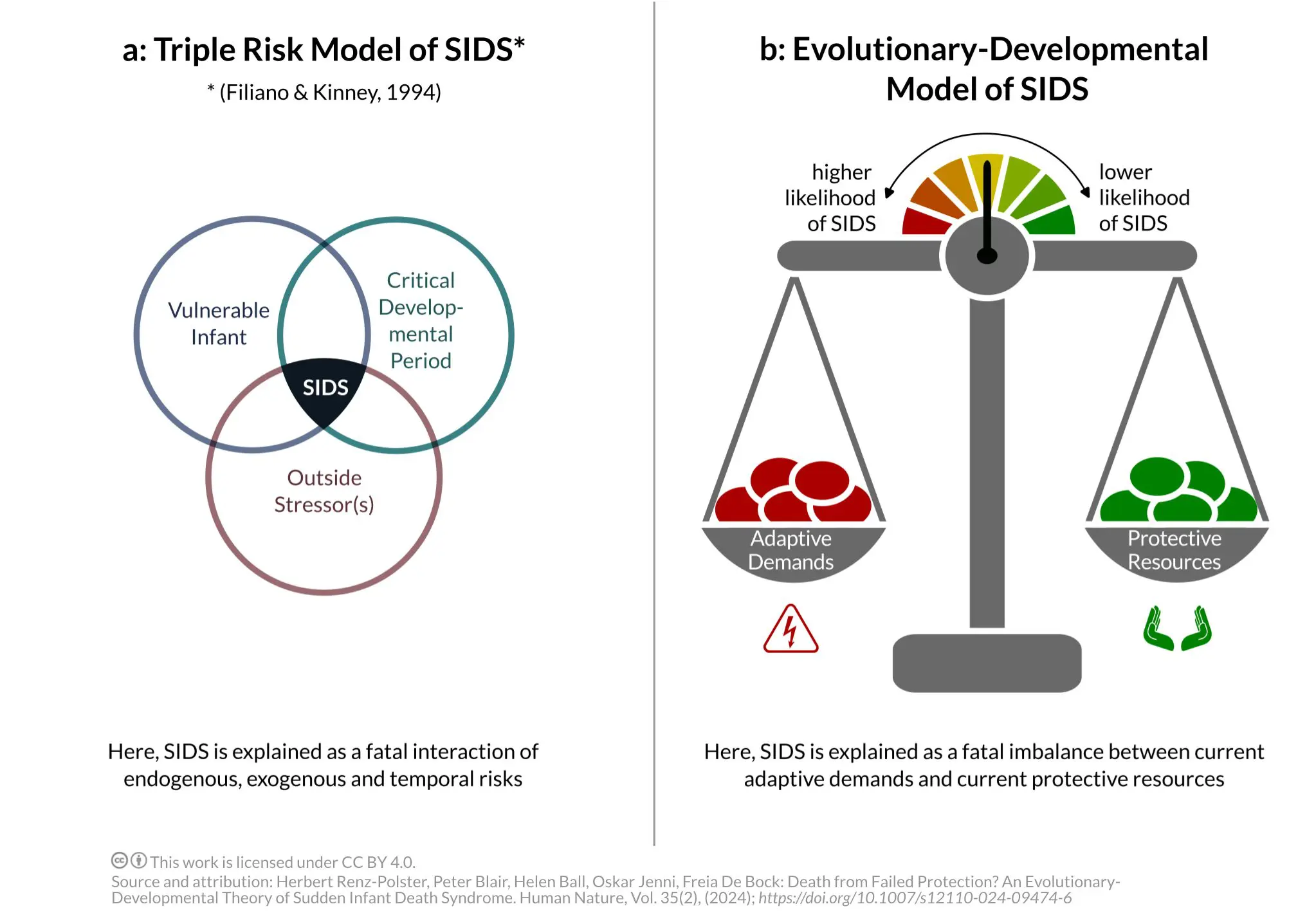
The classic triple-risk model compared with the evolutionary-developmental balance model of SIDS. Graphic licensed under CC BY 4.0; full attribution appears in the image.
Original publication
Renz-Polster H, Blair PS, Ball HL, Jenni OG, De Bock F. “Death from Failed Protection? An Evolutionary-Developmental Theory of Sudden Infant Death Syndrome.” Human Nature. 2024;35:153–196. Read the open-access paper at PubMed Central.
For a shorter orientation, read the publication summary.
References
- Klonoff-Cohen HS, Edelstein SL. A case-control study of routine and death-scene sleep position and sudden infant death syndrome in Southern California. JAMA. 1995;273(10):790–794.
- L’Hoir MP, et al. Risk and preventive factors for cot death in the Netherlands, a low-incidence country. European Journal of Pediatrics. 1998;157(8):681–688. DOI
- Li DK, et al. Infant sleeping position and the risk of sudden infant death syndrome in California, 1997–2000. American Journal of Epidemiology. 2003;157(5):446–455. DOI
- Mitchell EA, et al. Changing infants’ sleep position increases risk of sudden infant death syndrome. Archives of Pediatrics & Adolescent Medicine. 1999;153(11):1136–1141. DOI
- Moon RY, et al. Combined effects of sleeping position and prenatal risk factors in sudden infant death syndrome. Pediatrics. 1997;100(4):613–621. DOI
- Scragg R, et al. Bed sharing, smoking, and alcohol in the sudden infant death syndrome. BMJ. 1993;307:1312–1318. DOI
- Vennemann MM, et al. Bed sharing and the risk of sudden infant death syndrome. Journal of Pediatrics. 2012;160(1):44–48.e2. DOI
- Blair PS, et al. Bed-sharing in the absence of hazardous circumstances. PLOS ONE. 2014;9(9):e107799. Full text
- Filiano JJ, Kinney HC. A perspective on neuropathologic findings in victims of the sudden infant death syndrome: the triple-risk model. Biology of the Neonate. 1994;65(3–4):194–197. PubMed
- Moon RY, et al. Sleep-related infant deaths: updated 2022 recommendations for reducing infant deaths in the sleep environment. Pediatrics. 2022;150(1):e2022057990. AAP policy