The sudden, unexpected and medically unexplained death of an infant during sleep—Sudden Infant Death Syndrome, or SIDS—is one of the most horrific events imaginable. Nevertheless, SIDS remains scientifically enigmatic in many ways. We have published a new approach to explaining it.
The triple-risk model
The current explanatory model for SIDS is called the “triple-risk model.” It proposes that SIDS can happen when risk factors from three levels come together:
- Unfavorable environmental influences—outside stressors such as exposure to cigarette smoke, prone sleep position, sleeping with an intoxicated adult, heavy bedding, overheating or a soft mattress.
- Unfavorable internal influences—biological abnormalities in the infant that are not fatal on their own but may make the infant vulnerable, such as genetic abnormalities or changes in the brainstem.
- Unfavorable temporal influence—the observation that SIDS has a peak incidence between two and four months, a period therefore described as a “critical developmental period.”
This risk-based model is currently the most established explanation for SIDS.
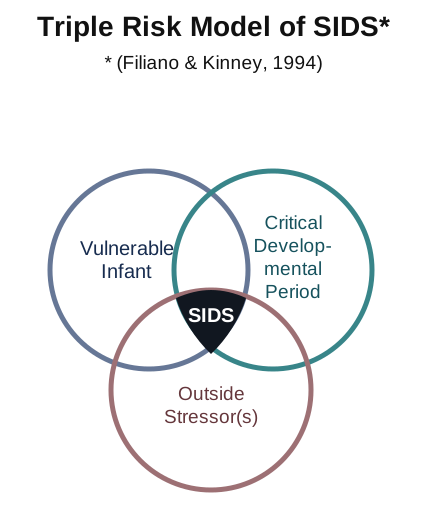
The classic triple-risk model of SIDS, after Filiano and Kinney (1994).
The limitations of the risk-based model
There is a fundamental problem with the risk-based explanatory paradigm: the described risks are ubiquitous. Almost every baby may eventually slip into the prone position, sleep in a room that is too warm, be covered incorrectly or encounter one of the many other external risk factors described in the literature. The vast majority of babies are exposed to one or more SIDS risk factors in everyday life.
In a 2023 analysis of pictures of sleeping babies posted on Instagram, for example, only 1.9% met the official recommendations for safe infant sleep. Every baby also enters the “critical” developmental phase between two and four months. And internal risks cannot currently be excluded completely because no general test for them exists.
It is easy to see how a risk-based interpretation of SIDS may have contributed to the common notion among parents and healthcare providers that SIDS can strike any infant at any time.
The “missing link”
At the same time, SIDS research shows that risks alone are poor predictors of SIDS. More than 99% of infants exposed to a given risk factor do not die of SIDS.
Of course, this does not mean that the risks do not count. That would be a misunderstanding. SIDS cases without at least one known risk factor are extremely rare, and these tragic events usually involve several risks at the same time. Clearly: the risks count.
Yet risks remain an incomplete explanation. The most interesting unanswered question may therefore extend beyond risk and touch on resilience: Which factors provide babies with protection against SIDS? And why does that protection fail in a few infants?
What makes babies resilient to SIDS?
Several unresolved findings illustrate the importance of resilience:
- The “grace period.” The most common causes of infant death generally affect newborns more frequently. SIDS follows a different pattern: infants are relatively rarely affected during the first month. Why should a three-month-old baby be more susceptible to typical SIDS risks than a three-week-old baby?
- The protective association of breastfeeding. We know that breastfeeding is associated with partial protection from SIDS. What could explain this association, and how might it arise?
- The evolutionary rationale. From an evolutionary-biology perspective, SIDS appears to be a nonsensical event. Why would a healthy infant suddenly die after nine months of extremely complex intrauterine development, without anyone being able to find a reason?
A new explanatory model is needed
The SIDS map still contains blank spaces, and they appear to relate to resilience. Do risk factors exert their power particularly when they are not matched by sufficient protective resources? Could SIDS ultimately reflect an imbalance between adverse and protective influences? If so, what are the protective influences, and where and how do they develop?
Over several years, I worked with an interdisciplinary group of scientists on the issue of SIDS-relevant protection. By bringing together findings from evolutionary theory, comparative behavioral research and developmental pediatrics, we developed an “evolutionary-developmental model of SIDS.”
Our paper—a comprehensive work of more than 40 pages—was published in Human Nature in 2024. Read the open-access paper at PubMed Central.
The model does not replace the triple-risk model or established safe-sleep recommendations. It asks researchers to add another question: alongside identifying risks, how can we explain the protective development that ordinarily allows infants to meet physiological challenges?
Continue with the detailed explainer, or read the model in brief.
References
- Filiano JJ, Kinney HC. A perspective on neuropathologic findings in victims of the sudden infant death syndrome: the triple-risk model. Biology of the Neonate. 1994;65(3–4):194–197. PubMed
- Renz-Polster H, Blair PS, Ball HL, Jenni OG, De Bock F. Death from failed protection? An evolutionary-developmental theory of Sudden Infant Death Syndrome. Human Nature. 2024;35:153–196. Full text
- Moon RY, et al. Characteristics of sudden unexpected infant deaths on shared and nonshared sleep surfaces. Pediatrics. 2024;153(3):e2023061984. Journal record
- Gessner BD, et al. Association between Sudden Infant Death Syndrome and prone sleep position, bed-sharing and sleeping outside an infant crib in Alaska. Pediatrics. 2001;108(4):923–927. Journal record